Chapter 1
71 verses
Section 129 verses
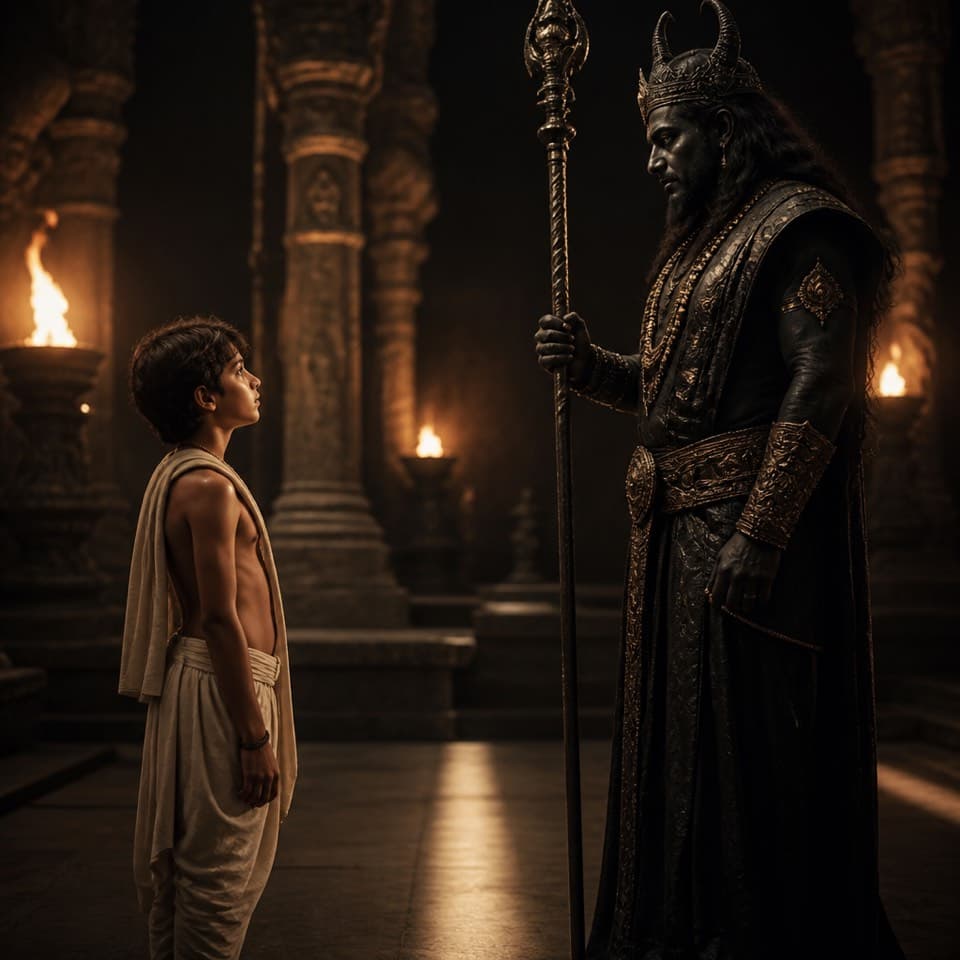
 1तस्य ह नचिकेता नाम पुत्र आसOnce, desirous of heaven, the son of Vajasrava (Gautama) gave (in a sacrifice) all that he possessed. He had a son Nachiketas by name.
 2त्ँह कुमार्ँसन्तं दक्षिणासु नीयमानासु श्रद्धाविवेश सोऽमन्यतWhen the presents were being distributed, filial anxiety (about the welfare of his father) entered into the heart of Nachiketas, who was still a boy, and he thought.
 3पीतोदका जग्धतृणा दुग्धदोहा निरिन्द्रियाः ।Joyless verily are those worlds to which a man goes by giving (presents in a sacrifice) cows which have drunk water, eaten grass, given their milk and are barren.
 4स होवाच पितरं तात कस्मै मां दास्यसीति ।Nachiketas said to his father: O father, to whom wilt thou give me,; he said this again and for the third time, the (enraged) father said: To Death I will give thee.
 5बहूनामेमि प्रथमो बहूनामेमि मध्यमः ।Nachiketas thought: Among many I go as the first; among many I go in the middle. What will be the work of Yama which today he has to do unto me?
 6अनुपश्य यथा पूर्वे प्रतिपश्य तथाऽपरे ।Nachiketas said: Remember how our forefathers acted; consider also how others now act. Like corn, the mortal decays and like corn he is born again. (Nachiketas entered into the abode of yama Vaivasvata. There was no one to receive him Yama has gone out.)
 7वैश्वानरः प्रविशत्यतिथिर्ब्राह्मणो गृहान् ।A Brahmin guest enters a house like fire. For him men give this peace-offering (to ench the fire or iet him). Bring water, O Vaivasvata (O son of Vivasvan, the sun).
 8आशाप्रतीक्षे सङ्गत्ँसूनृतां च इष्टापूर्ते पुत्रपशू्ँश्च सर्वान् ।Hope, expectation, company with good men, friendly discourse, sacrifices, pious gifts, sons and cattle-all these are destroyed in the case of the ignorant man, in whose house a Brahmin guest stays without taking food.
 9तिस्रो रात्रीर्यवात्सीर्गृहे मेऽनश्नन् ब्रह्मन्नतिथिर्नमस्यः ।(Yama said): O Brahmin, as thou a venerable guest, hast dwelt in my house three nights without eating, therefore choose now three boons in return. O Brahmin, my prostrations unto thee. May good befall me.
 10शान्तसङ्कल्पः सुमना यथा स्याद्वीतमन्युर्गौतमो माऽभि मृत्यो ।(Nachiketas said): O Death! as tge first of the three boons, I choose that Gautama, my father, be pacified, kind and free from anger towards me, and that he may know me and greet me, when I shall be sent away by thee.
 11यथा पुरस्ताद् भविता प्रतीत औद्दालकिरारुणिर्मत्प्रसृष्टः ।(Yama said): Through my favour, Auddalaki, the son of Aruni, will recognise you as before. He will sleep peacefully at night and when he sees you released from the mouth of death, will lose his anger.
 12स्वर्गे लोके न भयं किंचनास्ति न तत्र त्वं न जरया बिभेति ।(Nachiketas said): In the heaven there is no fear; thou art not there, O Death, and no one is afraid on account of old age. Having conered both hunger both hunger and thirst, one rejoices in heaven, being above sorrow.
 13स त्वमग्नि्ँस्वर्ग्यमध्येषि मृत्यो प्रब्रूहि त्ँश्रद्दधानाय मह्यम् ।O Death! thou knowest the fire-sacrifice which leads us to heaven; explain it to me, for I am full of faith. Those who live in the world attain immortality- this I ask as my second boon.
 14प्र ते ब्रवीमि तदु मे निबोध स्वर्ग्यमग्निं नचिकेतः प्रजानन् ।(Yama said): I will tell thee well, learn it from me, O Nachiketas. I know the fire that leads to heaven; know the fire which leads to heaven (which is the cause of aciring infinite worlds), and which again is the support of the universe and which is seated in the cavity (of the heart).
 15लोकादिमग्निं तमुवाच तस्मै या इष्टका यावतीर्वा यथा वा ।Yama then explained to him that fire-sacarifice, the source of the worlds, what bricks are reired for the altar, how many and how they are to be placed, and Nachiketas repeated all as explained. Then Yama, being pleased with him, said again.
 16तमब्रवीत् प्रीयमाणो महात्मा वरं तवेहाद्य ददामि भूयः ।Satisfied, magnanimous Death spoke to him: I give thee here this other boon, this fire-sacrifice shall be named after thee, and take thou this many-coloured chain.
 17त्रिणाचिकेतस्त्रिभिरेत्य सन्धिं त्रिकर्मकृत्तरति जन्ममृत्यू ।Whoever performs three times this sacrifice of Nachiketas fire and has been united with the three (father, mother and teacher) and has performed the three duties (study, sacrifice and alms-giving) overcomes birth and death. When he has understood this adorable bright, the omniscient fire born of Brahman and realised him, then he obtains everlasting peace.
 18त्रिणाचिकेतस्त्रयमेतद् विदित्वा य एवं विद्वा्ँश्चिनुते नाचिकेतम् ।He who knows the three Nachiketas fires, and propitates the Nachiketa fire with this knowledge, throws off the chains of death, goes beyound sorrow and rejoices in heaven.
 19एष तेऽग्निर्नचिकेतः स्वर्ग्यो यमवृणीथा द्वितीयेन वरेण ।This, O Nachiketas, is thy fire which leads to heaven and which thou hast chosed as thy second boon; people will call this fire thine alone. Choose now, O Nachiketas, thy third boon.
 20येयं प्रेते विचिकित्सा मनुष्येऽस्तीत्येके नायमस्तीतिं चैके ।(Nachiketas said): There is that doubt when a man is dead-some say he is and some he is not-this I should like to know, taught by thee. This is the third of my boons.
 21देवैरत्रापि विचिकित्सितं पुरा न हि सुविज्ञेयमणुरेष धर्मः ।(Nachiketas said): Thou sayest, O Death, that even the gods had doubts here and that this is not easy to know. Another teacher like thee is not to be found; surely, there is no other boon like this.
 22देवैरत्रापि विचिकित्सितं किल त्वं च मृत्यो यन्न सुविज्ञेयमात्थ ।Yama said: Choose sons and grandsons who may live a hundred years, herds of cattle, elephants, gold and horses. Choose the wide abode of the earth and live yourself as many years as you like.
 23शतायुषः पुत्रपौत्रान् वृणीष्व बहून् पशून् हस्तिहिरण्यमश्वान् ।If you can think of any boon eal to that, choose wealth and long life. Be a king, O Nachiketas, of the wide earth, I shall make thee the enjoyer of all desires.
 24एतत्तुल्यं यदि मन्यसे वरं वृणीष्व वित्तं चिरजीविकां च ।Whatever desires are difficult to attain in the world of mortals, ask for them according to they wish. These fair maidens with their chariots and musical instruments-such are indeed not enjoyable by mortals; be attended by them, I will give them to thee; but, O Nachiketas! do not ask the estion of the state of the Soul after death.
 25ये ये कामा दुर्लभा मर्त्यलोके सर्वान् कामा्ँश्छन्दतः प्रार्थयस्व ।(Nachiketas said): These things last till tomorrow (ephemeral). O Death, they wear out the vigour of all the senses. Even the longest life is verily short. Keep thou thy chariots, the dance and music.
 26श्वोभावा मर्त्यस्य यदन्तकैतत् सर्वेन्द्रियाणां जरयन्ति तेजः ।No man can be made happy by wealth. If we should obtain wealth and behold thee, we would only live as long as thou shalt sway. Only that boon which I have chosen is fit to be longed by me.
 27न वित्तेन तर्पणीयो मनुष्यो लप्स्यामहे वित्तमद्राक्ष्म चेत्त्वा ।What decaying mortal living in the world below and possessed of knowledge, after having approached the company of the undecaying and the immortal, will rejoice in long life, after he has pondered over the nature of the pleasures produced by song and sport (beauty and love)?
 28अजीर्यताममृतानामुपेत्य जीर्यन् मर्त्यः क्वधःस्थः प्रजानन् ।O Death! tell us that in which men have this doubt, and which is about the great hereafter. Nachiketas does not choose any other boon but that (concerning the Soul) of which the knowledge is hidden.
Thus ends the First Valli of the First Chapter.
 29यस्मिन्निदं विचिकित्सन्ति मृत्यो यत् सांपराये महति ब्रूहि नस्तत् ।O Death, tell us of that thing about which people entertain doubt in the context of the next world and whose knowledge leads to a great result. Apart form this boon, which relates to the inscrutable thing, Naciketa does not pray for any other.
Section 225 verses
 1अन्यच्छ्रेयोऽन्यदुतैव प्रेयस्ते उभे नानार्थे पुरुष्ँसिनीतः ।(Yama said): One is good, while another is pleasant. These two having different objects chain a man. Blessed is he who, between them choose the good alone, but he who chooses what is pleasant, loses the true end.
 2श्रेयश्च प्रेयश्च मनुष्यमेतस्तौ संपरीत्य विविनक्ति धीरः ।The good and the pleasant take hold of man; the wise man examines and distinguishes them. The wise man prefers the good (Sreya) to the pleasant, but the ignorant man chooses the pleasant (Preya) for the sake of the body.
 3स त्वं प्रियान् प्रियरूपा्ँश्च कामानभिध्यायन् नचिकेतोऽत्यस्राक्षीः ।Nachiketas, thou hast renounced objects of desires (such as sons and grandsons) and desirable objects of pleasant shape (as the heavenly nymphs), judging them by their real value. Thou hast not choosen the road of wealth, in which many men perish.
 4दूरमेते विपरीते विषूची अविद्या या च विद्येति ज्ञाता ।These two, ignorance and knowledge, are wide apart and lead to different points or goals. I believe Nahciketas to be one who desires for knowledge, for even many desires have not shaken thee.
 5अविद्यायामन्तरे वर्तमानाः स्वयं धीराः पण्डितंमन्यमानाः ।The ignorant, who live in the midst of darkness but fancy themselves as wise and learned, go round and round deluded in many crooked ways, as blind people led by the blind.
 6न सांपरायः प्रतिभाति बालं प्रमाद्यन्तं वित्तमोहेन मूढं ।The way to the hereafter is not apparent to the ignorant man who is foolish deluded by the deleusion of wealth. ‘This is the world,’ he thinks, ‘there is no other’-thus he falls again and again under my sway.
 7श्रवणायापि बहुभिर्यो न लभ्यः श्रृण्वन्तोऽपि बहवो यं न विद्युः ।He (the self) of whom many are not even able to hear, whom many, even when they hear of him, do not comprehend; wonderful is a man, when found, who is able to teach the self; wonderful is he who comprehends the Self, when taught by an able teacher.
 8न नरेणावरेण प्रोक्त एष सुविज्ञेयो बहुधा चिन्त्यमानः ।That Self, when taught by a man of inferior intellect is not easy to be known, as it is to be thought of in various ways. But when it is taught by a preceptor who is one with Brahman (who beholds no difference), there is no doubt concerning it, the Self being subtler than the subtle, and is not to be obtained by arguing.
 9नैषा तर्केण मतिरापनेया प्रोक्ताऽन्येनैव सुज्ञानाय प्रेष्ठ ।This knowledge is not to be obtained by argument, but is is easy to understand it, O dearest, when taught by a teacher who beholds no difference; thou hast obntained it now; thou art fixed in truth. May we have, O Nachiketas, an enirer like thee!
 10जानाम्यह्ँशेवधिरित्यनित्यं न ह्यध्रुवैः प्राप्यते हि ध्रुवं तत् ।I know that the treasure is transient, for that eternal is not obtained by things which are not eternal. Therefore, the Nachiketa fire has been propitiated by me with the perishable things and I have obtained the enteral.
 11कामस्याप्तिं जगतः प्रतिष्ठां क्रतोरानन्त्यमभयस्य पारम् ।The end of all desires, the foundation of the world, the endless rewards of sacrifice, the other shore where there is no fear, the praiseworthy, the great, the wide-extended sphere and the abode of the soul-all these thou has seen, and being wise, O Nachiketas, thou hast with firm resolve rejected all.
 12तं दुर्दर्शं गूढमनुप्रविष्टं गुहाहितं गह्वरेष्ठं पुराणम् ।The wise sage who, by means of mediation on his Self, recognises the Ancient, who is difficult to be seen, who is unfathomable and concealed, who is hidden in the cave of the heart, who dwells in the abyss, who is lodged in intelligence, indeed renounces joy and sorrow.
 13एतच्छ्रुत्वा संपरिगृह्य मर्त्यः प्रवृह्य धर्म्यमणुमेतमाप्य ।Having heard and well grasped this (the Self), the mortal, abstracting the virtous Atman, attaining this subtle Self, rejoices, because he has obtained what is cause for rejoicing. I think that the abode of Brahman is wide open for Nachiketas.
 14अन्यत्र धर्मादन्यत्राधर्मादन्यत्रास्मात् कृताकृतात् ।(Nachiketas said): That which thou seest as other than virtue and vice, other than cause and effect, other than the past and future, tell me that.
 15सर्वे वेदा यत् पदमामनन्ति तपा्ँसि सर्वाणि च यद् वदन्ति ।(Yama said): The goal (word) which all the vedas speak of (praise), which all penances proclaim and wishing for which they lead the life of a Brahmacharin, that goal (word) I will briefly tell thee-it is Om.
 16एतद्ध्येवाक्षरं ब्रह्म एतद्ध्येवाक्षरं परं ।This word is verily Brahman; this word is verily the highest he who knows this word, obtain, verily, whatever he desires.
 17एतदालम्बन्ँ श्रेष्ठमेतदालम्बनं परम् ।This is the best support. This is the highest support. He who knows this support is worshipped in the world of Brahman.
 18न जायते म्रियते वा विपश्चिन्नायं कुतश्चिन्न बभूव कश्चित् ।The intelligent Atman is not born, nor does he die; He did not spring from anything, and nothing sprang from Him; unborn, eternal, everlasting, ancient, He is not slain although the body is slain.
 19हन्ता चेन्मन्यते हन्तु्ँ हतश्चेन्मन्यते हतम् ।If the slayer thinks ‘I slay,’ if the slain thinks, ‘I am slain, then both of them do not know well. This slays not, nor is slain.
 20अणोरणीयान् महतो महीयानात्माऽस्य जन्तोर्निहितो गुहायाम् ।The Atman, subtler then the subtle, greater than the great, is seated in the heart of each living being. He who is free from desire, with his mind and the senses composed, beholds the majesty of the self and becomes free from sorrow.
 21आसीनो दूरं व्रजति शयानो याति सर्वतः ।Sitting He goes far; lying He goes everywhere. Who else, therefore, save myself, is able to comprehend the God who rejoices and rejoices not?
 22अशरीर्ँ शरीरेष्वनवस्थेष्ववस्थिम् ।The wise man, who knows the Atman as bodiless, seated firmly in perishable bodies, great and all-pervading, does never grieve.
 23नायमात्मा प्रवचनेन लभ्यो न मेधया न बहुना श्रुतेन ।This Atman cannot be attained by study of the vedas, nor by intelligence, no by much hearing. He whom the Self choose, by him the self can be gained. To him this Atman reveals its true nature.
 24नाविरतो दुश्चरितान्नाशान्तो नासमाहितः ।But he who has not turned away from bad conduct, whose senses are not subdued, whose mind is not concentrated, whose mind is not pacified, can never obtain this Atman by knowledge.
 25यस्य ब्रह्म च क्षत्रं च उभे भवत ओदनः ।Of whom, the Brahmana and the Kshatriya classes are (as it were) but food, and Death itself a condiment (or pickle), how can one thus know where that Atman is,
Thus ends the Second Valli of the First Chapter.
Section 317 verses
 1ऋतं पिबन्तौ सुकृतस्य लोके गुहां प्रविष्टौ परमे परार्धे ।The two who enjoy the fruits of their good works being seated in the cavity of the seat of the Supreme, the knowers of Brahman call them shadow and light, as also the performers of the fivehold fire and those who have propitiated three times the Nachiketa fire.
 2यः सेतुरीजानानामक्षरं ब्रह्म यत्परम् ।We are able to understand both, the Nachiketa fire which is the bridge of all sacrifices (to cross misery) and also the highest, indestructible Brahman, fearless and the refuge for those who wish to cross the ocean of Samsara.
 3आत्मान्ँ रथिनं विद्धि शरीर्ँ रथमेव तु ।Know the Atman as the Lord of the chariot, the body as the chariot; know the intellect as the charioteer and the mind again as the reins.
 4इन्द्रियाणि हयानाहुर्विषया्ँ स्तेषु गोचरान् ।They say, the senses are the horses and their objects are the roads; the Atman, the senses and the mind united, the wise call the enjoyer.
 5यस्त्वविज्ञानवान् भवत्ययुक्तेन मनसा सदा ।He who has no discrimination and whose mind is always uncontrolled, his senses are not controllable like vicious horses of a driver.
 6यस्तु विज्ञानवान् भवति युक्तेन मनसा सदा ।But he who has understanding and whose mind is always controlled, his senses are under control like good horses of a driver.
 7यस्त्वविज्ञानवान् भवत्यमनस्कः सदाऽशुचिः ।But he, who has no discrimination, and whose mind is not under control,and who is always inpure, does not reach the goal, but enters into the round of births and deaths.
 8यस्तु विज्ञानवान् भवति समनस्कः सदा शुचिः ।But he,who has understanding, who has his mind always under control, and who is pure, reaches that goal whence he is not born again.
 9विज्ञानसारथिर्यस्तु मनःप्रग्रहवान् नरः ।But he who has discerning intelligence as the driver and a well-controlled mind as the reins, reaches the end of his journey, that highest place of Vishnu.
 10इन्द्रियेभ्यः परा ह्यर्था अर्थेभ्यश्च परं मनः ।Beyond the senses are the rudiments of objects, beyond these rudiments is the mind, beyond the mind is the intellect, beyond the intellect is the great Self.
 11महतः परमव्यक्तमव्यक्तात् पुरुषः परः ।Beyond the great (Mahat) is the unmanifested (Avyakta). Beyond the Avyakta is the Purusha, beyond the Purusha there is nothing, that is the end, that is the highest goal.
 12एष सर्वेषु भूतेषु गूढोऽऽत्मा न प्रकाशते ।This Atman is hidden in all beings and does not shine forth, but it is seen by subtle seers through their sharp and subtle intellect.
 13यच्छेद्वाङ्मनसी प्राज्ञस्तद्यच्छेज्ज्ञान आत्मनि ।Let the wise sink his speech into the mind, the mind into the intellect and the intellect into the Great Atman and the Great atman into the Peaceful Atman.
 14उत्तिष्ठत जाग्रत प्राप्य वरान् निबोधत ।Arise, awake, having reached the great (teachers), learn (realise that Atman). Like the sharp edge of a razor is that path, difficult to cross and hard to treed,-thus the wise sya.
 15अशब्दमस्पर्शमरूपमव्ययं तथाऽरसं नित्यमगन्धवच्च यत् ।He, who has known that which is without sound, without touch, without from, without form, without decay, without taste, eternal, without smell, without beginning, without end, beyond the Mahat (great) and unchanging, is feed from the jaws of death.
 16नाचिकेतमुपाख्यानं मुत्युप्रोक्त्ँ सनातनम् ।A wise man who hears and repeats the ancient story of Nachiketas told by Yama, attains glory in the world of Brahman.
 17य इमं परमं गुह्यं श्रावयेत् ब्रह्मसंसदि ।Whoever with devotion recites before an assembly of Brahmins or at the time of Sraaddha of forefathers, this highest secret, obtains ther y immortality, obtains immortality.
Thus ends the Third Valli of the First Chapter.